Tell us about the job
Takes about a minute. No obligation.
A contractor sizing up a failed boiler in Fayette County starts with how old the heat exchanger is, whether the original install was done right, and how often the system has been serviced. 97 severe weather events were recorded in Fayette County, Iowa between 2015 and 2024. At roughly the national midpoint, that record puts severe weather squarely in the middle of what counties across the country see, which means weather load alone is not a strong explanation for why a boiler here stops working. Worn seals, sediment buildup, and cracked heat exchangers show up on their own schedule, driven by age and neglect far more than by storms outside.
Boilers in prewar houses carry a repair history that compounds over a long occupation, and the critical question once a technician opens the unit is whether the heat exchanger shows cracking or corrosion that a replacement section can actually address. Half the homes in Fayette County, Iowa were built in 1954 or earlier (2020-2024 ACS 5-year). Stock built that long ago was never designed around the sealed combustion and cast-iron sectional boilers that followed, so the distribution piping and the original radiation runs a contractor finds may have been adapted more than once. If a part number comes back discontinued, the scope shifts from component swap to section replacement or system evaluation, and that decision comes from what is physically inside the unit.
The Parts of a Boiler a Contractor Checks First
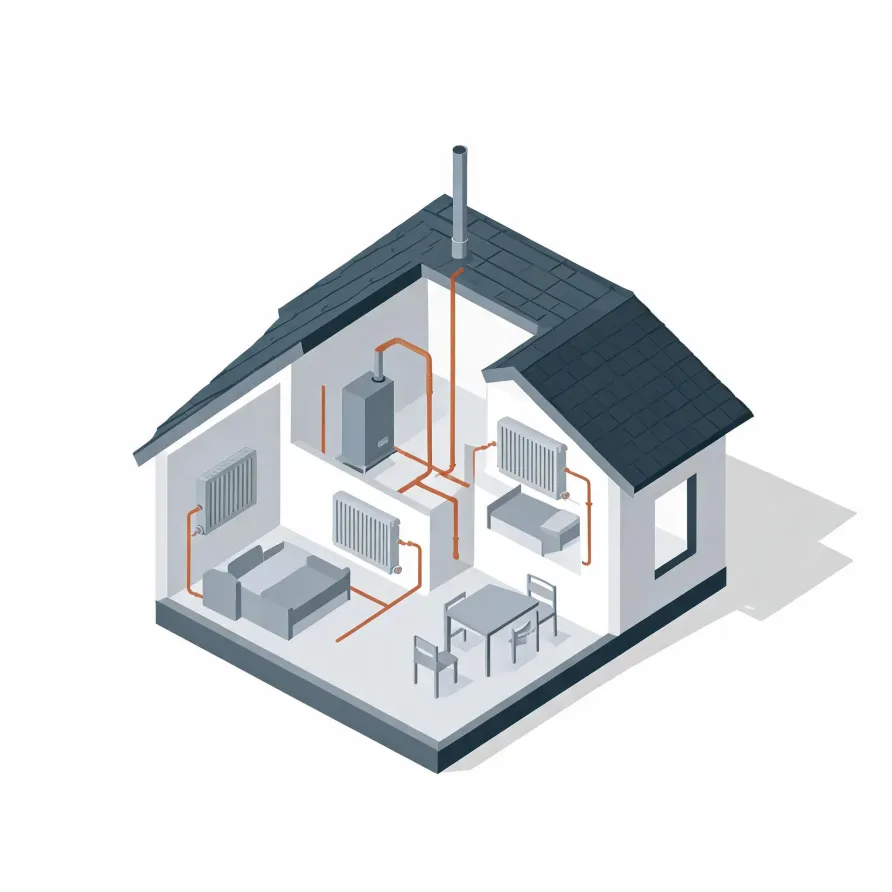
The boiler itself sits in the basement or utility room and is the part a contractor goes to first. It heats water and pushes it through the system. When the unit runs but rooms stay cold, or when it short-cycles or leaks, the problem usually starts here, at the heat exchanger, the burner, or the pressure vessel.
From the boiler, pipes carry hot water to radiators or baseboard units in each room, and back again. The circulator pump moves water through those pipes, and the expansion tank keeps pressure stable. A contractor checks the pump for signs it has seized, and the tank to see whether it has lost its charge.
The drawing shows a typical boiler layout, and a licensed contractor determines which components apply in your specific home.
Get matched in Fayette CountyFayette County, Iowa, by the numbers
97 severe weather events were recorded in Fayette County, Iowa between 2015 and 2024.
NOAA National Centers for Environmental Information, Storm Events Database, bulk CSV export, events 2015-01-01 through 2024-12-31.Half the homes in Fayette County, Iowa were built in 1954 or earlier (2020-2024 ACS 5-year).
U.S. Census Bureau, 2020-2024 American Community Survey 5-Year EstimatesFayette County, Iowa holds 9,320 housing units (2020-2024 ACS 5-year).
U.S. Census Bureau, 2020-2024 American Community Survey 5-Year EstimatesOwners occupy 76.5% of the occupied homes in Fayette County, Iowa (2020-2024 ACS 5-year).
U.S. Census Bureau, 2020-2024 American Community Survey 5-Year EstimatesCodes & Standards Governing Boiler Repair in Fayette County, Iowa1 rules & standards on record
Licensing Rules in Fayette County, Iowa
Iowa requires a state licence to install or repair HVAC, refrigeration, mechanical or plumbing systems, and to operate as a contractor, with exceptions listed in section 105.11.
Severe Weather Events in Fayette County
Fayette County weather puts real load on boiler systems. The more a heating system is forced to respond to outdoor extremes, the more repair work it accumulates over time, and that pattern is local.
97 severe weather events, 2015–2024. Source: NOAA National Centers for Environmental Information, Storm Events Database.